Rust, Coatings, Permits, Cost

Henderson Metal Roof Coating Questions

Straight answers to metal roof coating questions from Henderson building owners, from rust and screws to permits in each nearby town.

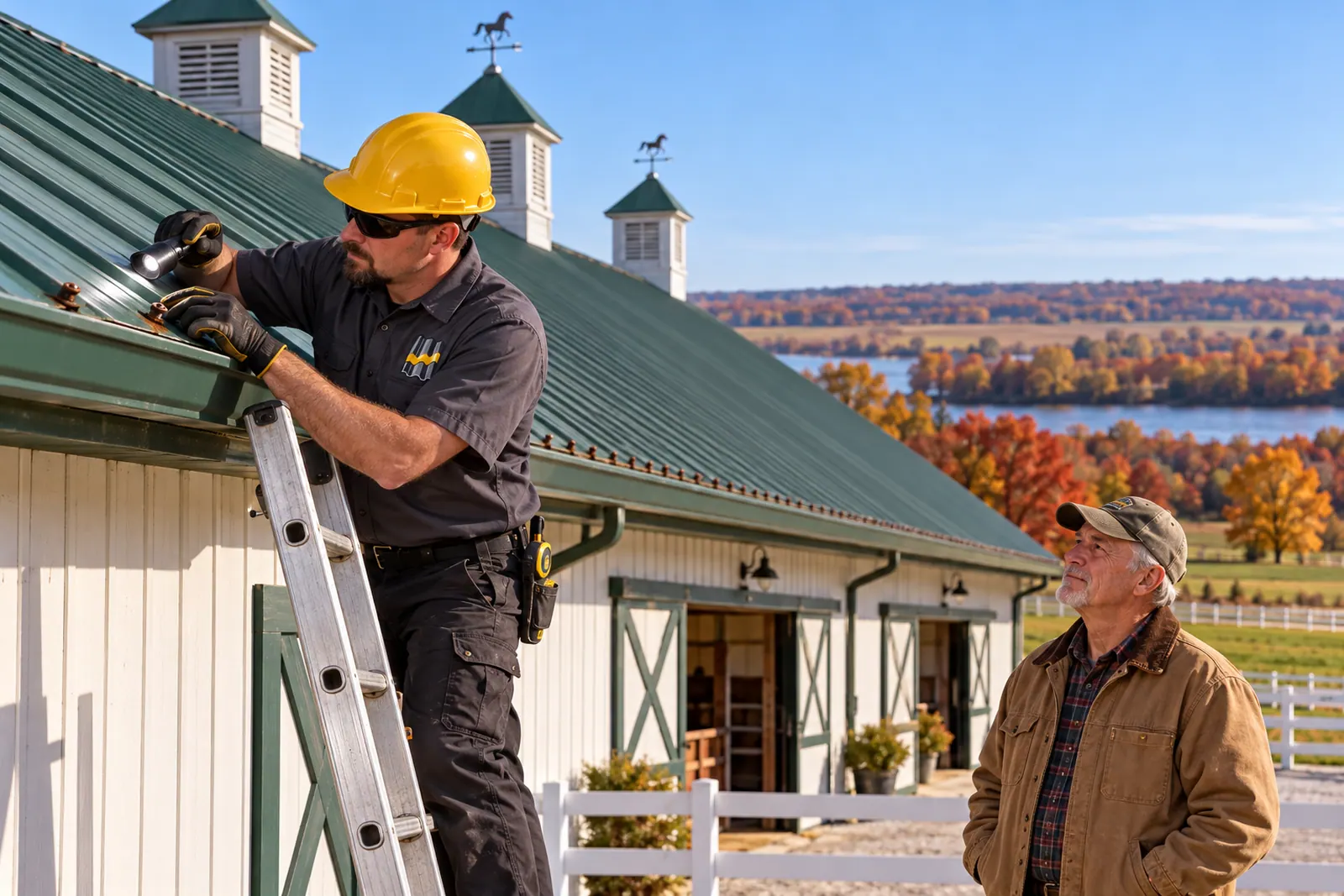
Roofer inspecting fasteners and panel laps on a commercial metal roof

Metal Roof Coating In Henderson, KY

Metal roof coating is a fluid-applied elastomeric layer rolled or sprayed over cleaned, repaired metal panels to seal seams, fasteners and rust.

Henderson Metal Roof Coating coats commercial metal roofs in Henderson, Henderson County, Kentucky, and handles silicone, acrylic, spray foam and shingle roof coating for businesses in Madisonville, Morganfield, Sebree, Sturgis and Providence.

Get A Free Ballpark Estimate

Metal Roof Coating Basics

What does a metal roof coating actually do on a commercial building?

A metal roof coating seals the panel surface, the fasteners and the laps under one continuous fluid-applied layer. On an exposed-fastener roof, most leaks start at screw washers, end laps and flashing, so the coating system is built around those spots first.

Light-colored coatings also reflect sunlight. The Cool Roof Rating Council directory lists tested reflectance and emittance values for rated roof products, which helps owners compare coatings on paper.

Coating protects steel that still has its strength. Panels rusted through or buckled get replaced first.

Which commercial buildings around Henderson are good candidates for metal roof coating?

Warehouses, shops, churches, offices, farm buildings and light industrial plants with metal roofs are the usual candidates. The roof needs firm purlins, panels that still hold fasteners, and rust limited to the surface instead of holes.

Good signs during an inspection:

  • Fasteners that tighten instead of spinning
  • Rust bloom that grinds back to bright metal
  • Laps and ridge caps that still sit tight
  • Gutters and skylight panels that can be fixed on their own

Wet insulation, sagging purlins or widespread perforation point to repair or re-panel work before any coating goes on.

Rust, Fasteners and Seams

Can you coat a rusty metal roof?

Surface rust can be coated once it is cleaned back and primed with a rust-inhibitive primer. Crews remove loose scale with wire brushes or grinders, rinse the panels, and spot-prime red rust before the base coat.

Rust that has eaten holes through a panel, a gutter bottom or a valley calls for patch panels or new metal first. A screwdriver pressed against the worst spots tells a lot: firm steel gets coated, soft steel gets cut out.

White rust on galvanized panels is a separate problem with its own cleaning step.

What happens to the screws and washers when a metal roof is coated?

Every exposed fastener gets checked, and loose or stripped screws are swapped for larger-diameter screws before coating. Rubber washers on older roofs crack from sun exposure, letting water track down the screw shank into the building.

After tightening, each fastener head is sealed. Common methods:

  • Brush-grade sealant dabbed over each head
  • Plastic fastener caps filled with sealant
  • Fabric patches over screw clusters at end laps and eave lines

Backed-out screws along ridge caps and eave trim rank among the most frequent leak points on exposed-fastener roofs around the Ohio Valley.

How do you seal panel laps and end laps before coating?

Side laps and end laps get a dedicated seam treatment before the field coat goes on. Crews clean the lap, apply a butyl or elastomeric seam sealer, and at end laps embed a strip of polyester reinforcing fabric in coating.

End laps run across the slope, so water pushes against them in every rain. Summer heat and winter cold work these joints open over time, which is why they get reinforcement in addition to the field coat.

Ridge caps, rake trim and the transitions where roof panels meet a wall receive the same fabric-and-coating detail.

Is standing seam metal prepared differently from exposed-fastener R-panel?

Standing seam and exposed-fastener R-panel fail in different places, so their preparation differs. R-panel needs work on hundreds of screw heads and every lap, while standing seam leaks more at seams, clips, penetrations and panel ends.

Prep itemExposed-fastener R-panelStanding seam
FastenersTighten, replace and seal every headHidden clips; few exposed screws
SeamsSide laps sealedSeam ribs checked for openings
End lapsFabric-reinforcedFewer, sealed where present
Common leak pointWashers and end lapsPenetrations and panel ends
Coating approachFull detail plus field coatDetail plus field coat per panel maker guidance

Some standing seam roofs only need detail work at penetrations and ends instead of a full field coat.

What is white rust, and does it affect coating?

White rust is a powdery white corrosion that forms on zinc-coated steel when moisture sits on it, and it shows up on galvanized panels and gutters. It interferes with adhesion, so it comes off with cleaning and abrasion before primer or coating goes on.

Signs to look for:

  • Chalky white deposits along panel ribs
  • Dull patches near ponding spots at the eave
  • Powdery film inside gutters and downspouts

After cleaning, an adhesion test patch confirms the coating bonds to the prepared surface. Galvalume panels with intact factory finish get a different primer choice than bare galvanized steel.

How are skylight panels, ridge caps and gutters handled during coating?

Each skylight panel, ridge cap and gutter gets its own repair before the main field coat goes down. Faded or cracked translucent skylight panels are best replaced, since coating would block the light they exist to let in.

  • Ridge caps: reseal closures and refasten caps that lift in wind.
  • Gutters: clear debris, seal seams and repair rusted bottoms.
  • Curbs and pipe boots: flash with fabric and coating.
  • Skylights: seal perimeters and mark them so crews stay off.

Skylight panels get masked off before spraying so overspray stays on the metal.

Choosing a Coating System

Is silicone or acrylic better for a metal roof in western Kentucky?

Silicone holds up better where water sits after rain, while acrylic works well on pitched metal that drains fast and recoats easily. Most metal roofs shed water quickly, so either can perform once laps and fasteners are sealed.

FactorSiliconeAcrylic
Ponding waterHandles it wellWeak under standing water
Cure conditionsWider weather windowNeeds dry, mild weather to cure
RecoatBonds best to more siliconeRecoats with acrylic easily
Dirt pickupHolds dirt over timeLower dirt pickup
Fit on metalLow-slope areas and eavesPitched panels with good drainage

Western Kentucky's humid summers and wet springs make cure timing a real factor in the choice.

When does silicone roof coating make sense on a commercial metal roof?

Low-pitch metal roofs, flat eave sections and spots where water lingers after a storm are where silicone fits best. It resists breakdown from ponding and sunlight, which matters at the low ends of long panels near gutters.

Good fits:

  • Low-slope warehouse roofs with a shallow pitch
  • Additions where a lower roof meets a taller wall
  • Roofs with recurring ponding at clogged gutters

Silicone needs a clean surface and a compatible primer over rust and galvanized metal. Future recoats go best with more silicone, since few products bond well to cured silicone.

When is acrylic roof coating the better pick?

Acrylic suits metal roofs with enough pitch to drain fast, especially where the owner wants a bright white finish and simple recoats later. Water-based acrylics clean up with water and have low odor, which helps on occupied offices and churches.

Acrylic needs dry weather and mild temperatures to cure, so application windows matter in Kentucky's spring and fall. A shower on fresh acrylic can wash film off the panels.

On a building with both pitched panels and a low-slope section, the low area is a candidate for silicone and the pitched area for acrylic, with the transition detailed carefully.

Can spray foam roofing go over an existing metal roof?

Spray polyurethane foam can be applied over metal panels to add insulation and form one continuous surface over the ribs. The foam fills the panel profile, then a protective silicone or acrylic coating covers it against sunlight.

FactorCoating onlySpray foam plus coating
Insulation addedLittleYes, foam adds R-value
ThicknessThinThicker; check edges and structure
Fasteners and lapsSealed one by oneBuried under foam
Edges and guttersMinimal changesTrim and gutters often need raising
Best fitSolid panels, enough insulationUnder-insulated buildings, irregular panels

Spray foam is weather-sensitive work that needs trained applicators and careful overspray control around parked vehicles.

Can you coat an asphalt shingle roof on a commercial building?

Shingle roof coating works on some commercial shingle roofs when the shingles are intact and the coating maker approves the product over shingles. Most requests come from strip centers, office buildings and churches that still carry shingle roofs.

Limits to check:

  • Curling, missing or brittle shingles rule it out.
  • Granule loss and exposed mat need repair first.
  • Shingle manufacturer terms can be affected by coating.
  • Ventilation and moisture in the space under the deck need review.

A coating will not rebuild worn shingles, and many tired shingle roofs are better off re-roofed. Metal additions on the same building can be coated alongside.

Climate and Weather Around Henderson

How does Henderson's weather affect a coated metal roof?

Henderson sees hot, humid summers and winters that swing back and forth across freezing, and both stress metal roofs. Steel panels expand on summer afternoons and contract on cold nights, working fasteners and laps loose over the years.

The coating has to flex with that movement without cracking, which is why elastomeric products are used instead of rigid paint. Morning dew on the panels also shapes the work day, since coating goes on dry metal only.

The National Weather Service office in Paducah issues forecasts and warnings for the Henderson area, and crews watch its outlook for rain and dew point before coating.

Does a white coating keep a metal building cooler?

Yes, a white or light-colored coating sends back more of the sun's energy than bare or faded metal, so the roof surface runs cooler on sunny days. Less heat soaking through the panels helps air-conditioned shops and offices, and helps uninsulated storage buildings feel less like an oven.

The Cool Roof Rating Council directory lists measured solar reflectance and thermal emittance for rated products, so owners can compare coatings by number. Dirt and mildew lower reflectance over time, and periodic washing restores some of it.

Actual comfort and energy effects vary with insulation, ventilation and how the building is used.

What about hail, ice and wind on a coated metal roof?

Hail can dent metal panels, and coating will not remove dents, though a flexible coating keeps sealing panels that are dented yet unbroken. Hail that punctures panels or cracks skylight panels calls for repair before coating.

Winter adds other stresses:

  • Ice at gutters and eaves pushes water back under laps.
  • Snow sliding off pitched panels can tear gutters loose.
  • Wind uplift pulls at ridge caps and rake trim with loose fasteners.

After a severe storm, a walk of the roof checks seams, ridge caps, gutters and skylight panels for damage. Insurance questions go to the building owner's carrier.

Prep, Application and Downtime

What are the steps to coat a commercial metal roof?

Coating a commercial metal roof starts with an inspection of panels, fasteners, laps and flashings, then moves through cleaning, repairs, priming and coating. Each step builds on the one before it.

  • Inspect Your Roof: check rust, fasteners, laps, gutters and skylight panels.
  • Clean: pressure-wash dirt, chalking and mildew off the panels.
  • Repair: replace bad panels and screws, fix gutters and trim.
  • Prime: spot-prime rust and galvanized areas.
  • Detail: seal fasteners, laps, curbs and ridge caps.
  • Coat: apply base and top coats at the specified thickness.
  • Check: measure film thickness and touch up thin spots.

Can our building stay open while the roof is coated?

Most businesses keep operating during a metal roof coating job because the work happens on top of the roof. Noise comes mainly from pressure washing and fastener work, and water-based acrylics have little odor.

Plan for these items:

  • Rooftop HVAC units sometimes shut down while nearby areas are sprayed.
  • Parking near the building edges gets limited for overspray control.
  • Access points for ladders or lifts are set with the building manager.
  • Deliveries and loading docks get scheduled around crew movement.

Silicone and solvent products carry more odor, so fresh-air intakes are planned around the spray zone.

How long does a fresh coating need before rain?

Each coating needs a dry cure window before rain, and that window varies by product, temperature and humidity. Acrylics are the most sensitive, since rain on uncured water-based coating can wash it off. Silicones tolerate moisture sooner after application.

Crews check the forecast, dew point and panel temperature before opening a pail. On humid Ohio Valley mornings, metal panels stay wet with dew until the sun clears them, which pushes start times later.

Product data sheets from the coating maker set the cure and recoat times for each coat, and crews follow those over any rule of thumb.

What happens around curbs, vents and rooftop units?

Every penetration through the panels gets flashed with fabric and coating before the field coat goes on. HVAC curbs, exhaust fans, plumbing vents and pipe supports are the usual leak points after fasteners and laps.

PenetrationCommon problemFix before coating
HVAC curbOpen corners, rusted baseSeal corners and add fabric
Pipe ventCracked bootReplace boot or wrap with fabric
Exhaust fanLoose flashingRefasten and seal
Conduit and supportsFailed sealantClean and reseal

Units slated for replacement soon are best swapped before coating, so the new curbs get detailed once.

Cost, Value and Taxes

What drives the cost of coating a commercial metal roof?

Roof size, condition and access drive the cost of coating a metal roof more than anything else. A clean roof with tight fasteners needs far less labor than one with heavy rust, failed laps and many penetrations.

Main cost drivers:

  • Square footage and roof pitch
  • Rust removal and panel replacement
  • Fastener count and lap length
  • Coating type, thickness and number of coats
  • Penetrations, curbs, skylight panels and gutters
  • Lift, ladder and fall protection setup for building height

Spray foam adds material and edge work, and shingle roofs add repair time for loose or damaged shingles.

Should we coat, restore, re-panel or replace the metal roof?

The right choice rests on panel strength, rust depth and how much water has reached the insulation and structure. Coating fits roofs in good shape, restoration adds heavier repairs, and re-panel or replacement handles roofs past repair.

OptionWhen it fitsWhat it involves
CoatLight rust, tight fastenersClean, prime, detail, coat
RestoreModerate rust, leaking lapsRepairs, screw replacement, full detail, coat
Re-panelSections rusted throughNew panels in damaged areas, then coat
ReplaceWidespread failure, wet insulationNew roof system

Checking the underside of the panels and the insulation from inside the building helps separate these options on older structures.

Can a roof coating qualify for Section 179 expensing?

Roofs on existing nonresidential buildings are listed as qualified real property improvements for Section 179 in IRS Publication 946. For 2026, the deduction limit is $2,560,000, reduced dollar for dollar once qualifying property placed in service exceeds $4,090,000.

Points to raise with a tax advisor:

  • Residential rental property is excluded.
  • Whether to book the coating as a roof improvement or a repair is your tax advisor's call.
  • Timing of when the work is placed in service affects the tax year.

A CPA should review the facts for your building before you plan around the deduction.

Will utilities pay rebates for a reflective roof coating?

Rebate programs vary by utility and change often, so ask your electric provider before work starts instead of counting on one. Inside the City of Henderson, Henderson Municipal Power and Light is the city's own electric utility, while buildings outside the city are served by other providers.

The utility name on the electric bill tells you whom to call. Ask whether any program covers commercial roof reflectance, what paperwork it requires, and whether pre-approval comes first.

A rated product from the Cool Roof Rating Council directory gives documented reflectance values if a program asks for them.

Permits, Codes and Utilities

Do you need a permit to coat a commercial metal roof in Henderson County?

Permit needs for roof coating vary by jurisdiction and scope, so the building's location decides which office to ask. Inside Henderson city limits, the City of Henderson Office of Code Enforcement issues construction permits, and its permit page notes that permits come from that office and/or the State of Kentucky.

Outside the city, Henderson County lists a County Codes Department with a codes administrator and building inspector. Re-panel work, structural repairs and rooftop electrical changes are the items to raise with the office.

Permit status gets confirmed with the correct office before crews mobilize.

Which office handles building permits in each town?

Each town in the service area falls under a different city, county or state contact, and the Kentucky Department of Housing, Buildings and Construction posts county-by-county contact sheets.

TownCountyBuilding contact to start with
Henderson (city)HendersonCity Office of Code Enforcement
Henderson (outside city)HendersonHenderson County Codes Department
MadisonvilleHopkinsCity of Madisonville; DHBC Hopkins County sheet
MorganfieldUnionState building inspector on DHBC Union County sheet
SturgisUnionState building inspector; city office for electrical
SebreeWebsterState building inspector on DHBC Webster County sheet
ProvidenceWebsterState building inspector; Webster County officials in Dixon

The Union and Webster County sheets list no local building inspector and send local electrical inspection questions to the County Judge Executive's office or the city office where the work happens.

Questions by Town

Who handles permits for coating a warehouse roof inside Henderson city limits?

The City of Henderson Office of Code Enforcement handles construction permits inside city limits, and the city applies the Kentucky Building Code, the International Building Code with Kentucky amendments. Some permits come through the State of Kentucky as well.

For a riverfront warehouse or downtown storefront with a metal roof, the call to the city covers whether the scope counts as repair or alteration. Re-panel work, new skylight panels and rooftop electrical changes are the details to mention.

The state's Henderson County contact sheet lists a separate local building inspector for the city and for the county.

What changes for a metal building just outside Henderson city limits?

Outside city limits, Henderson County's codes department takes the place of the city's code enforcement office for building questions. The county lists a county engineer and a codes administrator and building inspector, and it posts separate electrical inspection contacts for city and county work.

Farm shops, equipment sheds and storage buildings in rural Henderson County bring long runs of exposed-fastener panels. Those roofs come with:

  • Heavy screw counts along every purlin line
  • Open eaves where birds nest under ridge caps
  • Gutters, if any, that need outlets cleared before coating

The electric provider on these buildings also differs from the city's Henderson Municipal Power and Light, which matters for rooftop unit shutdowns.

Which county rules apply to coating a metal roof in Madisonville?

Madisonville is the county seat of Hopkins County, so its building questions run through the City of Madisonville and the state's Hopkins County contact sheet, separate from Henderson County. Owners should start with the city for buildings inside Madisonville limits.

Coating jobs in Madisonville bring the same checklist to that call:

  • Scope: coating only, or re-panel and structural repair too
  • Electrical: any rooftop unit disconnects or rewiring
  • Access: lifts in city streets or shared parking lots

Hopkins County buildings sit farther from the Ohio River than Henderson's, so river-stage questions rarely drive roof timing there.

Is roof weather in Madisonville different from Henderson's?

Both Madisonville and Henderson fall under the National Weather Service office in Paducah, and storms crossing western Kentucky reach both. Crews still check the Hopkins County forecast zone by itself, since a line of storms can hit one town and miss the other.

Madisonville sits inland, south of Henderson, so its morning conditions can differ. For coating work, that means:

  • Separate dew-point and rain checks on the morning of application
  • A dry panel test at the Madisonville site before priming
  • Cure timing judged on local conditions instead of Henderson's

Rust patterns on Madisonville metal roofs follow the same rule as anywhere: laps, washers and gutters first.

Who inspects commercial building work in Morganfield?

The state's Union County contact sheet lists no local building inspector, so the state building inspector covers Union County, including Morganfield. Morganfield is the Union County seat, which puts the County Judge Executive's office in town for local electrical inspection questions.

For a metal roof coating in Morganfield, the practical steps are:

  • Call the City of Morganfield about local requirements.
  • Contact the state building inspector listed for Union County if structural or re-panel work is planned.
  • Route rooftop electrical work through the County Judge Executive's office or city office.

Coating-only work with no structural change is the simplest scope to clear.

Can farm buildings and machine sheds around Morganfield be coated?

Farm buildings and machine sheds in the farmland around Morganfield can be coated when their panels and purlins are solid. Agricultural metal buildings used for business count as commercial work, while houses fall outside the service.

Agricultural roofs bring their own wear:

  • Fertilizer and chemical storage speeds corrosion on panel undersides and fasteners.
  • Livestock barns hold moisture that rusts purlins and screw tips.
  • Open-sided sheds catch wind under the eaves and lift trim.

Grain dust and bird droppings get washed off thoroughly before primer, and corroded fasteners get replaced instead of capped.

Who handles electrical inspection for rooftop unit work in Sturgis?

For rooftop units in Sturgis, the state's Union County sheet directs local electrical inspection questions to the city office where the work happens or the County Judge Executive's office in Morganfield. Sturgis is a separate city within Union County, so checking with Sturgis city hall comes first.

Rooftop unit work comes up on coating jobs when:

  • Curbs are rusted and the unit has to be lifted
  • Disconnects or conduit cross the roof panels
  • A unit is being replaced at the same time as the coating

Building permits in Union County fall to the state building inspector, because the sheet lists no local one.

What should Sturgis building owners near the Ohio River watch for on metal roofs?

Sturgis sits close to the Ohio River, and buildings in low areas near the river deal with damp conditions that keep panels and gutters wet longer. Longer wet time speeds rust at laps, washers and gutter bottoms.

Inspection points for Sturgis metal buildings:

  • Mildew and algae on north-facing slopes
  • Red rust at end laps where water lingers
  • Clogged downspouts that back water onto the eave
  • Rusted gutter hangers and outlets

Ground flooding is a site issue, separate from the roof, but downspouts that discharge away from foundations help both.

Is Sebree under Henderson County or Webster County rules?

Sebree is in Webster County, so building questions go through the state's Webster County contact sheet instead of Henderson County offices. That sheet lists no local building inspector, which puts building inspection with the state building inspector.

Sebree sits on US 41 near the Henderson County line, and some owners assume Henderson County rules apply. Before a coating job, check:

  • The county on the property tax bill
  • Sebree city hall for any local requirement
  • Electrical inspection contacts for rooftop unit work

Getting the county right first avoids calling the wrong permit office.

Can a shingle-roofed church or office along US 41 in Sebree be coated?

A shingle-roofed church or office in Sebree can be coated only when the shingles are flat, firmly attached and covered by a coating product approved for shingles. Churches and offices along a highway like US 41 often pair a shingle main roof with a metal fellowship hall or shop addition.

Roof areaFirst checkLikely path
Shingle main roofCurling, granule loss, soft deckingShingle coating or re-roof
Metal additionFasteners, end laps, rustMetal roof coating
Joint between themFlashing at the wallFabric and coating detail

Treating both roof types in one mobilization keeps the joint detail consistent.

Who inspects commercial roof work in Providence?

Providence is in Webster County, where the state's contact sheet lists no local building inspector, so the state building inspector covers commercial building work. Dixon is the Webster County seat, which places the County Judge Executive's office there for county-level electrical questions.

A Providence owner planning a coating job can work through these contacts:

  • Providence city hall for local requirements inside city limits
  • The state building inspector for structural or re-panel scope
  • Webster County officials in Dixon for county electrical questions

Coating-only scopes with no structural change are the simplest to clear in Webster County.

How should a Providence building with mixed roof sections be coated?

A Providence building with mixed sections gets one coating plan that assigns silicone, acrylic or shingle coating by roof area. Older downtown commercial buildings often combine a low-slope rear section, a pitched metal front and small add-on roofs.

SectionTypical issueCoating choice
Low-slope rearPonding near drainsSilicone
Pitched metal frontLoose fasteners, end lapsAcrylic or silicone
Small shingle additionGranule lossShingle coating if approved

Transitions between sections get fabric and coating before the field coats, since that seam is where mixed roofs leak first.

Getting Started

What should a building owner have ready before a metal roof inspection?

Roof access details, leak history and past repair records are the items to have ready before a metal roof inspection. Knowing where water shows up inside helps match interior stains to fasteners, laps or curbs on top.

Useful items:

  • Roof access point, ladder or hatch location
  • Photos of ceiling stains and wet insulation
  • Dates of hail or wind events
  • Plans for new rooftop units or skylight panels
  • Building use, hours and loading dock schedule

The roof walk then covers panels, rust, laps, gutters, ridge caps and penetrations section by section.

How do we start a metal roof coating project in Henderson or nearby towns?

Starting a metal roof coating project begins with a roof inspection that checks rust, fasteners, laps, skylight panels and gutters. From that walk, the owner learns whether the roof fits coating, restoration, re-panel or replacement, and which coating suits each section.

Next come practical steps:

  • Confirm permit needs with the city, county or state office for the building's town.
  • Ask the electric utility about any reflective roof program.
  • Pick a season window with dry, mild weather.
  • Plan rooftop unit shutdowns and parking around the work.

Buildings in Henderson, Madisonville, Morganfield, Sebree, Sturgis and Providence follow the same sequence.

Still Have A Question About Your Roof?

Call us with the details, or send the roof size and condition for a ballpark range.

Tap To Call (270) 236-5481